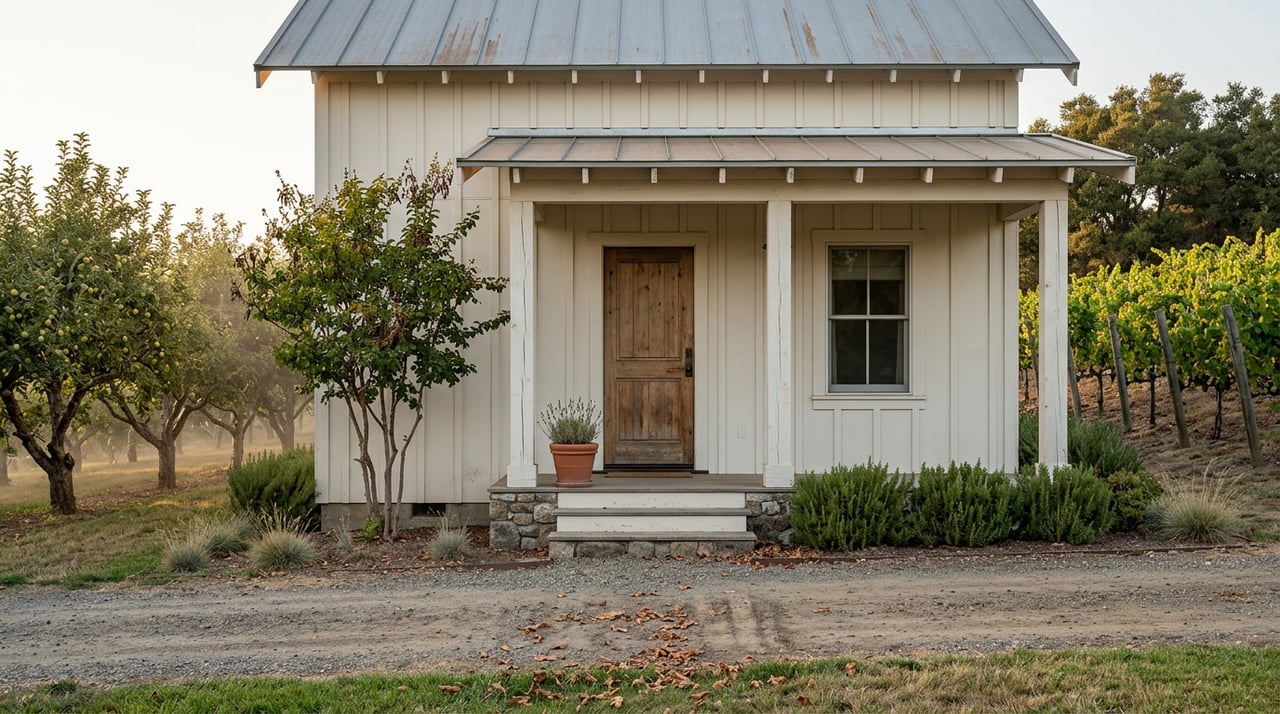
There is no downtown to speak of. No city hall, no plaza, no strip of storefronts that reads as a center. Corralitos is unincorporated Santa Cruz County, a scatter of orchards, vineyards, and roadside businesses along Hames Road, Corralitos Road, and Freedom Boulevard, and a longtime local musician once described the whole place to GoodTimes as "literally a wide spot in the road."
And yet if you live here, you already know the calendar fills up. Sunday mornings pull people to the same gravel lot. Friday nights do too. So does a benefit concert that happened this past June for a reason that has nothing to do with wine or sausage: the roof needed fixing.
That lot belongs to the Corralitos Cultural Center, and once you notice how much of the neighborhood's actual social life runs through it, the rest of Corralitos starts to look different. The wineries, the historic meat market, the orchard up the road: they are all real and all worth your time. But none of them is what makes Corralitos feel like a place instead of a stretch of addresses. That job falls to a nonprofit running out of a converted church, mostly on volunteer labor.
The Sunday Market That Built the Habit
Every Sunday from 11 a.m. to 3 p.m., the Cultural Center's parking lot becomes the Corralitos Farm & Garden Market, a small operation that has grown steadily for roughly fifteen years under organizer Ken Konviser. It started as a produce stand. It is now a mix of seasonal fruit, home-baked bread and pastries, honey, soup, handmade knits, and pottery, all from vendors who pay a modest weekly fee to set up.
Small as it sounds, it is apparently how people find this town. In that same GoodTimes piece, a touring musician named Barr, reached by phone while preparing for a show in Pennsylvania with the band America, described discovering the Cultural Center through exactly that market and the Friday night open mic that follows it: "We just fell in love with the CCC, particularly how welcoming it was." A musician who tours nationally found his way into Corralitos through a folding table of produce and a Sunday jam session. That is not a coincidence. It is the only front door the neighborhood really has.
The Friday open mic runs 6:30 to 9:30 p.m., signups at 6:30, first act at 7, and it is followed most Saturdays by an acoustic open jam from 2 to 4 p.m. where any skill level is welcome. None of this requires a ticket or a reservation. It just requires showing up, which is exactly the point.
Where the Roof Money Came From
The Cultural Center itself traces back to 1990, when two resident-run groups, the Corralitos Valley Community Council and the Corralitos Valley Research and Education Association, bought the old Grace Baptist Church building and, with support from a Packard Grant, helped establish nearby Aldridge Park. Thirty-some years later, the building needed real repair, and the fix came the way most things do here: a concert.
On June 6, 2026, the Center hosted "Raise the Roof!" in its outdoor theater, known simply as the Backyard, with a suggested donation of $20 to $50, a silent auction, and sets from Formerly Alien, Fox & Kail, and Ripatti Rose. Admission included barbecue from Corralitos Market and Sausage Company, which tells you something on its own: even a fundraiser for a leaking roof runs on the same butcher shop that has fed this town since the 1950s. One local organizer, identified only as Tatum in the coverage, put the last decade in blunt terms: "We survived Covid, but we were in the doldrums. Now, we've shifted into a different gear."
That gear shift shows. What began as a modest open-mic room now hosts drum circles, clothing swaps, youth camps, songwriter nights, and guitar classes alongside the weekly market, according to the Cultural Center's own account of its history. None of it charges much. Most of it depends on people volunteering their Sunday mornings and Friday evenings.
The Sausage Company That Predates the Roads Around It
Corralitos Market and Sausage Company's roots go back to the late 1880s, when it operated as the Corralitos Cash Store about a block from where it sits today. Jim and Barbara Prendergast modernized it in the 1940s. In 1956, incoming postmaster Joe Cutler asked to rent out the store's unused smokehouse, and his uncle taught him the curing trade. By 1957, Cutler had renamed the place Corralitos Market and Sausage Company, and it has operated under that name for almost seventy years, according to the market's own history page. Today it makes more than thirty varieties of fresh and smoked sausage, along with custom cuts of beef, pork, lamb, and poultry, and it still shows up, literally, at the Cultural Center's own fundraisers.
Six Wineries That Run on Their Own Clock
The commercial side of Corralitos is real too, and it centers on the Corralitos Wine Trail, six family-owned wineries sitting at the southern, coastal edge of the Santa Cruz Mountains appellation. Richard Alfaro, who has been making wine here for 25 years, explained to Lookout Santa Cruz why the microclimate works: daytime temperatures can hit 85 degrees while marine air drops nights into the 40s, ideal conditions for pinot noir and chardonnay.
| Winery | What sets it apart |
|---|---|
| Alfaro Family Vineyards | Its dry-farmed Trout Gulch pinot noir vines, planted 42 years ago and never irrigated |
| El Vaquero Winery | The trail's only stop not surrounded by its own vineyard, sitting at the Freedom Boulevard and Corralitos Road intersection |
| Windy Oaks Estate | The farthest and highest of the group, 1,000 feet up, built around pinot noir with an acre each of chardonnay and syrah |
| Storrs Winery | Introduced a self-guided beaker flight during the pandemic that visitors still use to taste and compare pours |
Tasting fees across the trail generally run $15 to $25 for three to six pours, often waived with a bottle purchase, according to Lookout's 2023 guide to the trail. Nicholson Vineyards and Lester Estate Wines round out the six, each sourcing estate-grown fruit and controlling the process from planting through the glass.
Two Dates Already Worth Circling
The Freedom Rotary Club's annual Uncork Corralitos garden party returns to Alladin Nursery on October 17, 2026, per Eventbrite's listing for the event. It is worth knowing where the money actually goes. In its first year, 2022, it raised more than $20,000 for Pajaro Valley Shelter Services. In 2023, proceeds funded a new kitchen floor at Second Harvest Food Bank and a small-business support program through El Pájaro Community Development Corporation. In 2024, following the floods that hit the area earlier that year, the event funded a ten-week emotional resilience program for students at Pajaro Middle School. Same wineries pouring, different cause every year, all decided by a volunteer Rotary board.
The other date has no fixed number attached to it yet. Luz del Valle, the u-pick apple orchard and horse ranch that traces back to the Silva Ranch founded around 1883 by Manuel Joaquin Silva and his wife Caroline Augusta Alm, sits on Hames Road, the same road as the Cultural Center. Its gates typically reopen as summer turns to fall, and when they do, it is one more reason residents end up crossing paths at the same handful of addresses.
What Actually Holds This Together
None of the businesses in Corralitos need each other to survive. The wineries would keep pouring, the Market would keep smoking sausage, the orchard would keep its trees, regardless of who else showed up. What turns those separate businesses into an actual community is the unpaid work happening in that Cultural Center parking lot and in Rotary meetings across town, the same small group of people running a farm market for fifteen years, organizing a benefit concert to patch a roof, and deciding each October which local nonprofit gets the proceeds.
That pattern is spreading, not shrinking. Lito's Lounge, housed in the historic Five Mile House, recently secured its liquor license and launched "Equinox Nights," an evening series built around local artists, musicians, and small businesses, according to the Pajaronian's coverage. Corralitos Brewing Company keeps its own steady rotation of taps a short drive down Freedom Boulevard. Each new venue adds another node to the same informal network, one built less on commerce and more on people willing to show up and keep the lights on.
If you already live here, that is worth knowing the next time you're deciding whether a Sunday morning trip to the market or a Friday night at the open mic is worth the drive. It usually is, because in a place with no downtown, that parking lot is doing the job one would otherwise do.
If you're weighing a move within Corralitos or Larkin Valley, or just want a broker who already knows which roads get you there fastest, Daniel Oster has spent years working this exact stretch of Santa Cruz County. Let's Connect.